By Tanja Yardley | Brainnovation Network | March 19, 2026

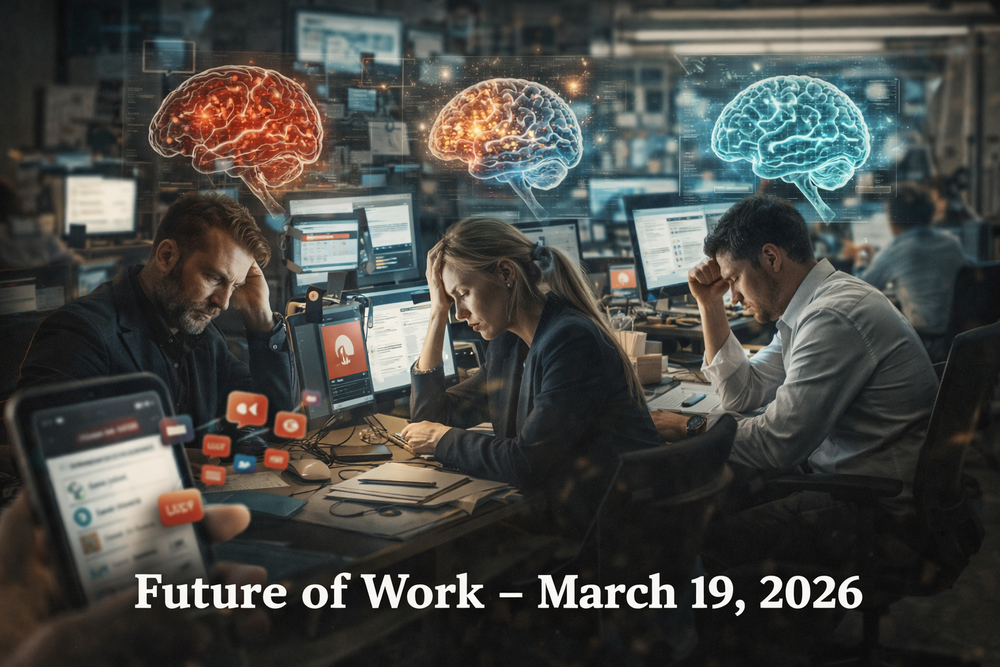
Many employees aren’t beginning their workday fully focused and energized—they’re starting from a place of fatigue. By the time the day begins, they may already feel mentally overloaded, under-rested, and distracted.

This isn’t just anecdotal. According to a 2023 report from Gallup, nearly 44% of employees worldwide report feeling stressed during much of the workday. Meanwhile, Microsoft’s Work Trend Index found that employees are interrupted—by meetings, emails, or messages—every 2 minutes on average.

Despite this, expectations remain unchanged: be sharp, responsive, and productive.

Over time, this level of cognitive demand has become normalized. What might once have been considered unsustainable is now routine—yet its effects are often framed as individual performance issues rather than system-level patterns.


🧠 What’s Actually Happening

This issue goes beyond general stress. It reflects how ongoing demands affect mental and physiological capacity.

Research from the American Psychological Association (APA) shows that chronic workplace stress can impair memory, reduce attention span, and affect decision-making ability. At the same time, studies in cognitive science suggest that frequent task-switching can reduce productivity by up to 40%.

Today’s work environment is defined by:

  • Constant digital communication
  • Shifting priorities
  • Information overload
  • Ongoing uncertainty (economic, technological, organizational)

Common effects include:

  • Reduced ability to concentrate
  • Increased irritability
  • Mental fatigue earlier in the day
  • Slower decisions
  • Reduced creative thinking

This is less about motivation and more about capacity. When cognitive load is high, the brain prioritizes efficiency over depth—favoring quick responses instead of thoughtful, strategic work.


⚠️ Why It Matters for Organizations

Organizations often evaluate performance without considering the conditions behind it.

Data from Deloitte’s Global Human Capital Trends report highlights that 77% of employees have experienced burnout at their current job, with over half citing multiple instances.

When employees operate under sustained cognitive strain:

  • Productivity becomes inconsistent
  • Errors increase (Harvard Business Review links fatigue to higher mistake rates)
  • Communication clarity declines
  • Decision-making becomes reactive
  • Engagement drops

Gallup also reports that low engagement costs the global economy trillions annually in lost productivity.

At the same time, organizations continue investing in productivity tools. While valuable, these can unintentionally increase cognitive load if not implemented thoughtfully.

Sustainable performance depends not just on systems—but on the capacity of the people using them.


❌ Where Approaches Often Fall Short

When performance dips, many organizations respond by increasing pressure:

  • More meetings
  • More oversight
  • More tools
  • Faster timelines

However, research from Stanford University shows that productivity per hour declines sharply when work exceeds 50–55 hours per week, and drops even further beyond that.

Common challenges include:

  • Treating burnout as a time-management issue
  • Adding tools without reducing complexity
  • Overlooking mental fatigue
  • Rewarding constant availability

These approaches are often well-intentioned—but may intensify the problem rather than resolve it.


🔄 A More Sustainable Perspective

A more effective approach is to treat performance and capacity as interconnected.

Research from the World Health Organization (WHO) identifies burnout as an occupational phenomenon linked to unmanaged workplace stress—not individual weakness.

When employees have the conditions to maintain focus and recover:

  • Decision-making improves
  • Collaboration strengthens
  • Creativity increases
  • Productivity becomes more consistent

Supporting capacity doesn’t lower expectations—it creates the conditions for meeting them.


🛠️ Practical Adjustments Leaders Can Consider

Evidence-based shifts include:

Reduce unnecessary input
Fewer communication channels = less cognitive overload (McKinsey reports employees spend ~28% of their week managing email alone).

Protect focus time
Studies show uninterrupted work improves both speed and quality of output.

Recognize early signs of strain
Behavior changes often reflect overload, not disengagement.

Encourage recovery
Short breaks improve performance and reduce errors (University of Illinois research).

Clarify priorities
Clear goals reduce ambiguity and mental strain.


🌍 Looking Ahead

The future of work will be shaped by technology—but sustained performance will depend on human capacity.

Organizations that understand how to support attention, energy, and focus will be better positioned to adapt and grow.

Because performance isn’t just about capability—it’s about the conditions that allow capability to be used effectively.

Tanja Yardley
Brainnovation Network Contributor
Advancing Brain Health, Human Performance & The Future of Work

and Tags: #Future of Work #Brainnovation Network #Future of Work #Burnout #Nervous System #Human Performance #Workplace Health #Leadership

Share this article
The link has been copied!