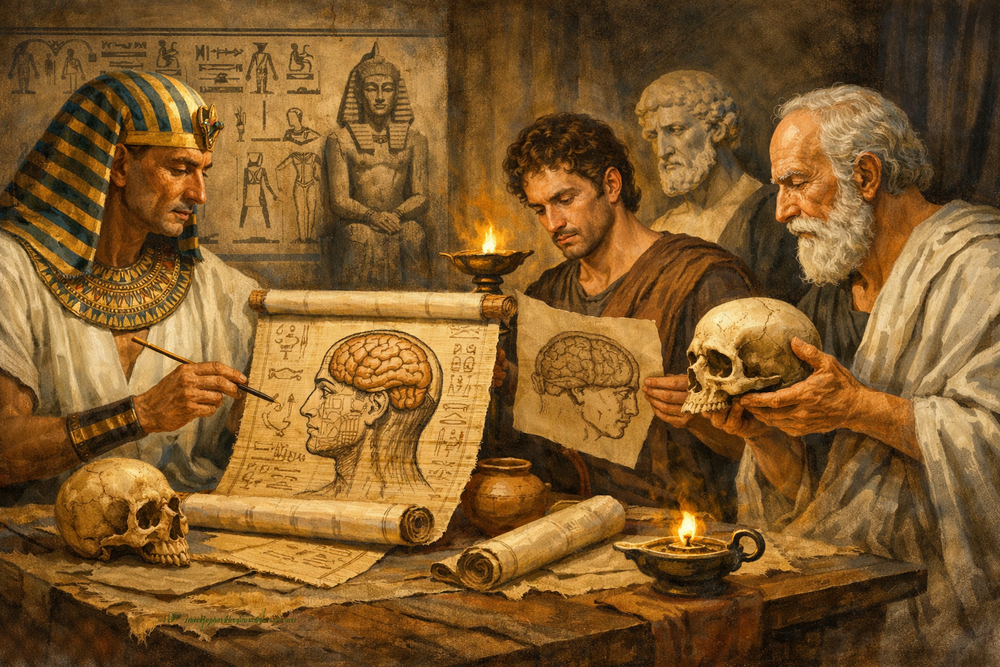
What the Egyptians and Greeks got right—and wrong—about brain function
By Robert Skinner | Brainnovation News | March 18, 2026
Part 1 of 10: The Evolution of Brain Health Series
Subscribe to Brainnovation News for practical insights on AI, brain health, and the future of human potential.
Opening Perspective
Today, we take it for granted that the brain controls thought, memory, and decision-making. But for much of human history, that idea didn’t exist. Early civilizations didn’t just misunderstand the brain—they often dismissed it entirely.
To understand modern brain health, you have to start at the beginning—when science, belief, and guesswork were all mixed together.
Early Beliefs: When the Brain Didn’t Matter
In ancient Egypt, one of the most advanced civilizations of its time, the brain was considered largely unimportant.
During mummification, embalmers carefully preserved organs like the heart, lungs, and liver—but the brain was removed and discarded. The prevailing belief was that the heart, not the brain, was the center of intelligence, emotion, and the soul.
This wasn’t ignorance—it was the best interpretation they could make based on observation. The heart beats, reacts to fear, and changes under stress. The brain? Silent and hidden.
The Greek Turning Point
The first serious shift came from the Greeks—particularly Hippocrates, often called the father of medicine.
Hippocrates proposed something radical for his time:
The brain is the seat of intelligence.
This marked a major turning point. Instead of relying purely on tradition or belief, Greek thinkers began to observe, question, and reason.
Later philosophers, including Aristotle, didn’t fully agree—he still believed the heart played a central role—but the debate itself pushed understanding forward.
For the first time, the brain was being taken seriously.
What They Got Right—and Wrong
Looking back, it’s easy to dismiss these early ideas—but that would be a mistake.
What they got right:
- The Greeks correctly linked the brain to thought and perception
- They introduced observation and logic into medical thinking
What they got wrong:
- No real understanding of brain structure
- No concept of neurons or electrical signals
- Heavy reliance on philosophy over experimentation
Still, this period laid the groundwork for everything that followed.
Why This Still Matters Today
Here’s the reality most people miss:
We are still, in many ways, at the early stages of understanding the brain.
Modern neuroscience has come a long way—but assumptions are still being challenged. Ideas about memory, learning, aging, and even intelligence continue to evolve.
The lesson?
👉 What we “know” today may be incomplete tomorrow.
And that matters—especially as we move into an era where artificial intelligence is beginning to work alongside human thinking.
What This Means Today
- Brain health is not a fixed concept—it has evolved over thousands of years
- Misunderstanding the brain is nothing new
- Staying adaptable and open to new knowledge is essential
Key Takeaways
- Ancient Egyptians believed the heart—not the brain—controlled human behavior
- Greek thinkers like Hippocrates introduced the idea of the brain as the center of intelligence
- Early science was limited, but it set the foundation for modern neuroscience
- Our understanding of the brain is still evolving today
Robert Skinner is an AI-assisted business systems developer and publisher focused on the intersection of brain health, technology, and innovation.
Connect on LinkedIn: https://www.linkedin.com/in/rlskinner/
#Brain Health #Neuroscience #History of Science #AI and Society #Cognitive Science #Brainnovation News