How centuries of limited progress shaped what we now understand about the human mind

By Robert Skinner | Brainnovation News | March 18, 2026
Part 2 of 10: The Evolution of Brain Health Series

Subscribe to Brainnovation News for practical insights on AI, brain health, and the future of human potential.

Opening Perspective

Progress is rarely a straight line.

After early insights from the Greeks, you might expect brain science to accelerate. Instead, it slowed—significantly. For centuries, understanding of the brain didn’t advance much at all.

But that doesn’t mean nothing happened. The Middle Ages laid groundwork in a different way—through philosophy, belief systems, and early attempts to explain human thought without the tools we have today.

When Observation Took a Back Seat

During the Middle Ages, much of scientific inquiry was shaped—and often limited—by religious and philosophical frameworks.

Dissection of the human body was restricted in many regions. Without direct observation, scholars relied heavily on ancient texts, especially those from Greek and Roman thinkers.

Instead of experimenting, they interpreted.

And that changed the direction of brain study.

The Ventricular Theory of the Brain

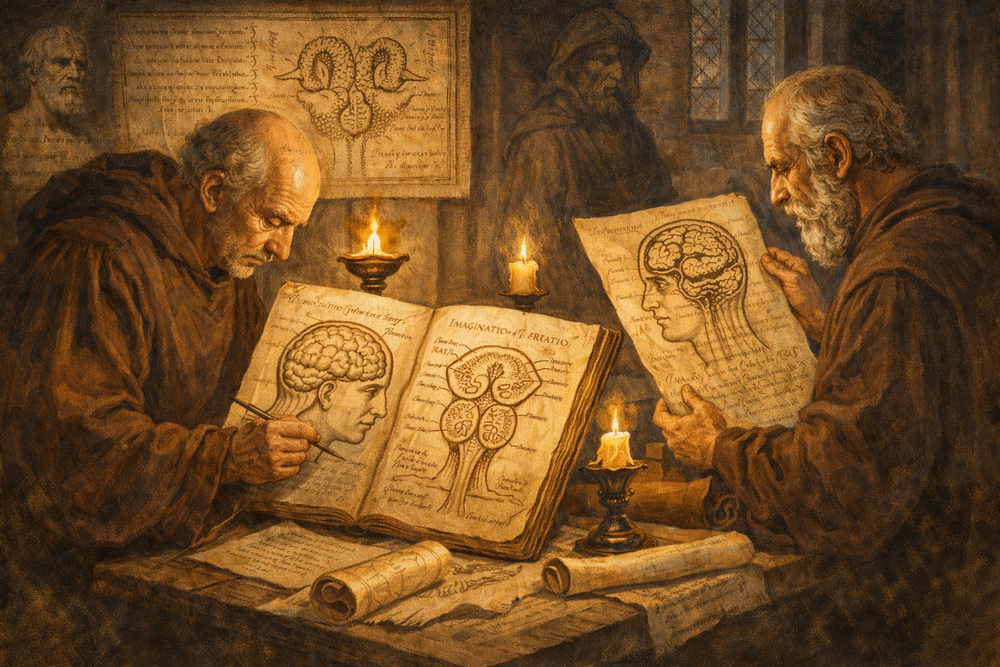
One of the dominant ideas of the time was the ventricular theory—the belief that mental functions were located in the fluid-filled cavities of the brain.

These ventricles were thought to control:

  • Imagination
  • Reasoning
  • Memory

Scholars created detailed diagrams mapping these “functions” inside the brain, despite having no real understanding of neural structure.

It wasn’t entirely wrong—but it missed the real mechanics completely.

Philosophy Over Biology

Thinkers like Thomas Aquinas attempted to reconcile human thought with theology.

The focus wasn’t just how the brain worked—but why humans think at all.

This led to important questions:

  • What is consciousness?
  • What separates humans from animals?
  • Is thought physical—or spiritual?

These are still relevant questions today.

What Held Progress Back

Let’s be direct—there were real limitations:

  • No microscopes
  • No understanding of neurons
  • Limited anatomical access
  • Heavy reliance on inherited ideas

In simple terms:

👉 They were trying to solve a mechanical problem with philosophical tools.

But Not a Wasted Era

Here’s where most people get it wrong.

The Middle Ages are often dismissed—but they shouldn’t be.

This period:

  • Preserved earlier knowledge
  • Raised fundamental questions about the mind
  • Kept intellectual inquiry alive

Without that foundation, later breakthroughs wouldn’t have happened as quickly.

Why This Still Matters Today

We’re not as far removed from this as we think.

Even today:

  • We still debate consciousness
  • We still don’t fully understand memory
  • We still rely on models that may later prove incomplete

The Middle Ages remind us of something important:

👉 Limited tools lead to limited conclusions.

And that applies just as much today as it did then.

What This Means Today

  • Knowledge evolves with tools
  • Assumptions must be challenged regularly
  • Even flawed models can move thinking forward

Key Takeaways

  • Brain science slowed during the Middle Ages due to limited tools and restrictions
  • The ventricular theory dominated understanding of mental function
  • Philosophy and theology shaped thinking more than biology
  • This period preserved knowledge and raised key questions still relevant today

Robert Skinner is an AI-assisted business systems developer and publisher focused on the intersection of brain health, technology, and innovation.
Connect on LinkedIn: https://www.linkedin.com/in/rlskinner/

TAGS: #Brain Health #Neuroscience #History of Science #Cognitive Science #AI and Society #Brainnovation News

Share this article
The link has been copied!